About
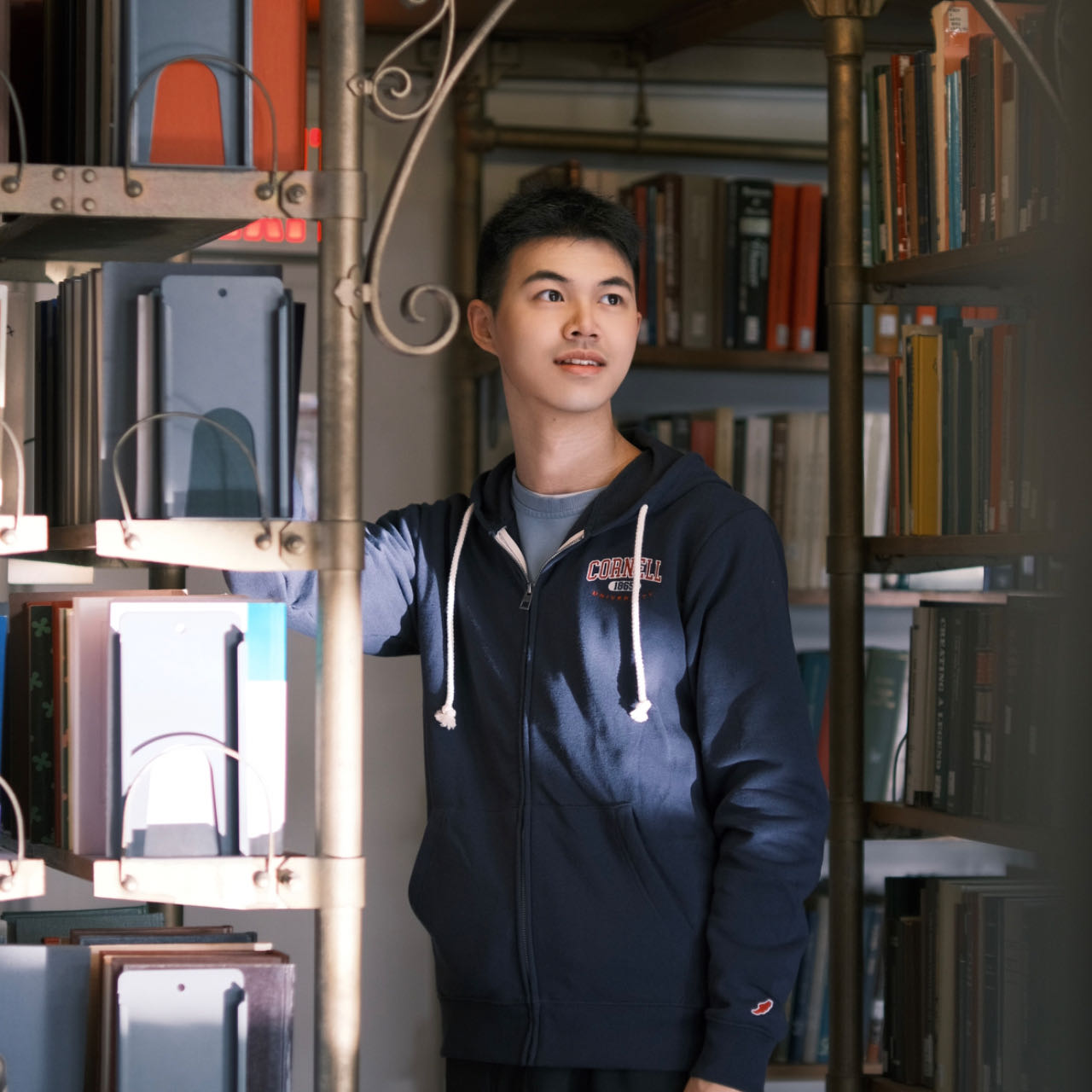
Hello! I am a 2nd-year Ph.D. student in Computer Science at Johns Hopkins University, advised by Tianmin Shu. I’m also a part-time student researcher at Meta FAIR, mentored by Jason Weston. My research is funded by the Amazon AI PhD Fellowship.
I received bachelor’s degrees in Honors Computer Science and Mathematics from NYU Courant (2020–2024), where the CS Department recognized me as its Most Promising Student. I was as a research intern at MIT (2023), advised by Josh Tenenbaum. I received an Outstanding Paper Award at ACL 2024 for my work on multimodal Theory of Mind.
I’m interested in developing AI systems with advanced social intelligence (ASI). My current areas of focus include:
- My works push the frontier of machine Theory of Mind (ToM), teaching AI systems to understand people's minds (e.g., goals, beliefs) based on their behavior (e.g., motion, speech). This line of research has led to widely used algorithms and benchmarks recognized as ACL'24 Outstanding Paper, AAAI'25 Oral, and NeurIPS'25 Spotlight.
- More specifically, my research pioneers the connection between the deliberate human-like reasoning of agent models and the adaptability of language models. It advances ToM reasoning by grounding it in cognitive theories, leveraging multi-modal, multi-agent and multi-perspective data, and scaling to long-context, complex scenarios.
- We advocate for an era of real-world human interaction, where models learn from real users' diverse goals and preferences, adapt to situational demands, and scale with actual usage. We introduce Reinforcement Learning from Human Interaction (RLHI), which learns directly from user conversations and outperforms RLHF at the user level.
- I initiated and co-organized RSS Workshop on Continual Robot Learning from Humans.
I love mentoring undergraduates—several of my mentees have been recognized with top research honors. Please fill out this application form and/or send me an email if you’re interested in working with me!
Besides academics, I enjoy playing Go, piano, badminton, swimming, and so much more.
News
- [Oct, 2025] Excited to be awarded the Amazon AI PhD Fellowship!
- [Oct, 2025] Invited talk @ Google on “Reinforcement Learning from Human Interaction”.
- [Sep, 2025] AutoToM is accepted by NeurIPS 2025 as a Spotlight Presentation!
- [June, 2025] Co-organized the Workshop on Continual Robot Learning from Humans at RSS 2025.
- [June, 2025] I was selected as a Notable Reviwer for ICLR 2025.
- [Jan, 2025] MuMA-ToM is accepted by AAAI 2025 as an Oral Presentation!
- [Sep, 2024] Invited talk @ University of Washinton on “Towards Multimodal Theory of Mind”.
- [Aug, 2024] MMToM-QA won the Outstanding Paper Award at ACL 2024! It was covered by Futurity, Synced, and JHU News.
Recent Publications
For a more complete list, please see my publication page or Google Scholar page.
Feel free to check out my undergrad projects. A mountain of gratitude to those who have kindly mentored and inspired me with their vision and passion!
Selected Honors & Awards
- Amazon AI PhD Fellowship, 2025
- Notable Reviewer, ICLR 2025
- Outstanding Paper Award, ACL 2024
- Presidential Honors Scholar and Summa cum Laude, New York University, 2024
- Computer Science Prize for the Most Promising Student, New York University (1 person/year), 2023
- Dean’s Undergraduate Research Fund, New York University, 2023
- COMAP International Scholarship Award (Top 0.1%), 2022
- MAA Award in Mathematical Contest in Modeling (Top 0.1%), 2022
- Bronze Medal of Shing-Tung Yau Computer Science Award (Top 1%), 2019
- Finalist of FIRST Robotics Competition World Championship (Top 0.2%), 2019
- NFLS Outstanding Student Leader Award and Zhou Enlai Scholarship (Top 1%), 2018
- First Prize of Chinese Mathematical Olympiad (Top 0.1%), 2018
- Champion of International Regions Mathematics League, 2018